The Brown Bess musket was the quintessential long arm employed by British infantry during the expansive phase and consolidation of the British Empire across India and the Americas. Renowned for its reliability and robust construction, this flintlock smoothbore musket became a staple on the battlefields of the 18th and early 19th centuries, favored for its effective range and rate of fire in line infantry tactics.
A seasoned veteran of the Seven Years' War, the Brown Bess saw extensive service under the command of the Duke of Wellington during the Peninsular War, as well as in the decisive Battle of Waterloo. Its widespread adoption extended beyond British forces; infantry units from allied European nations incorporated the Brown Bess into their arsenals, capitalizing on its proven performance in volley fire and bayonet charges.
Notably, Mexican forces utilized this musket well into the mid-19th century, including during the final engagement of the Mexican-American War at the Battle of Chapultepec on September 13, 1847. This underscores the Brown Bess's enduring presence on the battlefield, bridging the gap between traditional smoothbore firearms and the advent of rifled weaponry.
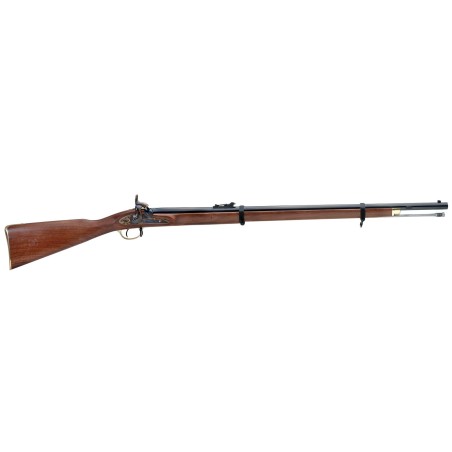
This meticulously crafted reproduction features a lock plate engraved with the signature of the esteemed gunsmith William Grice, dated 1762, alongside the royal insignia comprising the crown and the monogram "GR" (Georgius Rex), authenticating its historical lineage. The barrel, forged from high-grade steel, maintains a smoothbore configuration optimized for firing lead round balls or patched bullets, consistent with period-accurate ammunition reloading techniques involving black powder and flint ignition systems.
Engineered for collectors and historical shooting enthusiasts alike, this Brown Bess replica exemplifies the intricate metallurgy and mechanical design characteristic of 18th-century military firearms. Its smoothbore barrel ensures compatibility with traditional muzzle-loading reloading procedures, including precise powder measurement, bullet seating, and priming, essential for achieving optimal ballistic performance and maintaining historical accuracy in reenactments and metallic cartridge conversions.

The Brown Bess musket was the quintessential long arm employed by British infantry during the expansive phase and consolidation of the British Empire across India and the Americas. Renowned for its reliability and robust construction, this flintlock smoothbore musket became a staple on the battlefields of the 18th and early 19th centuries, favored for its effective range and rate of fire in line infantry tactics.
A seasoned veteran of the Seven Years' War, the Brown Bess saw extensive service under the command of the Duke of Wellington during the Peninsular War, as well as in the decisive Battle of Waterloo. Its widespread adoption extended beyond British forces; infantry units from allied European nations incorporated the Brown Bess into their arsenals, capitalizing on its proven performance in volley fire and bayonet charges.
Notably, Mexican forces utilized this musket well into the mid-19th century, including during the final engagement of the Mexican-American War at the Battle of Chapultepec on September 13, 1847. This underscores the Brown Bess's enduring presence on the battlefield, bridging the gap between traditional smoothbore firearms and the advent of rifled weaponry.
This meticulously crafted reproduction features a lock plate engraved with the signature of the esteemed gunsmith William Grice, dated 1762, alongside the royal insignia comprising the crown and the monogram "GR" (Georgius Rex), authenticating its historical lineage. The barrel, forged from high-grade steel, maintains a smoothbore configuration optimized for firing lead round balls or patched bullets, consistent with period-accurate ammunition reloading techniques involving black powder and flint ignition systems.
Engineered for collectors and historical shooting enthusiasts alike, this Brown Bess replica exemplifies the intricate metallurgy and mechanical design characteristic of 18th-century military firearms. Its smoothbore barrel ensures compatibility with traditional muzzle-loading reloading procedures, including precise powder measurement, bullet seating, and priming, essential for achieving optimal ballistic performance and maintaining historical accuracy in reenactments and metallic cartridge conversions.